
No-shows in December: the deposit policy that holds up
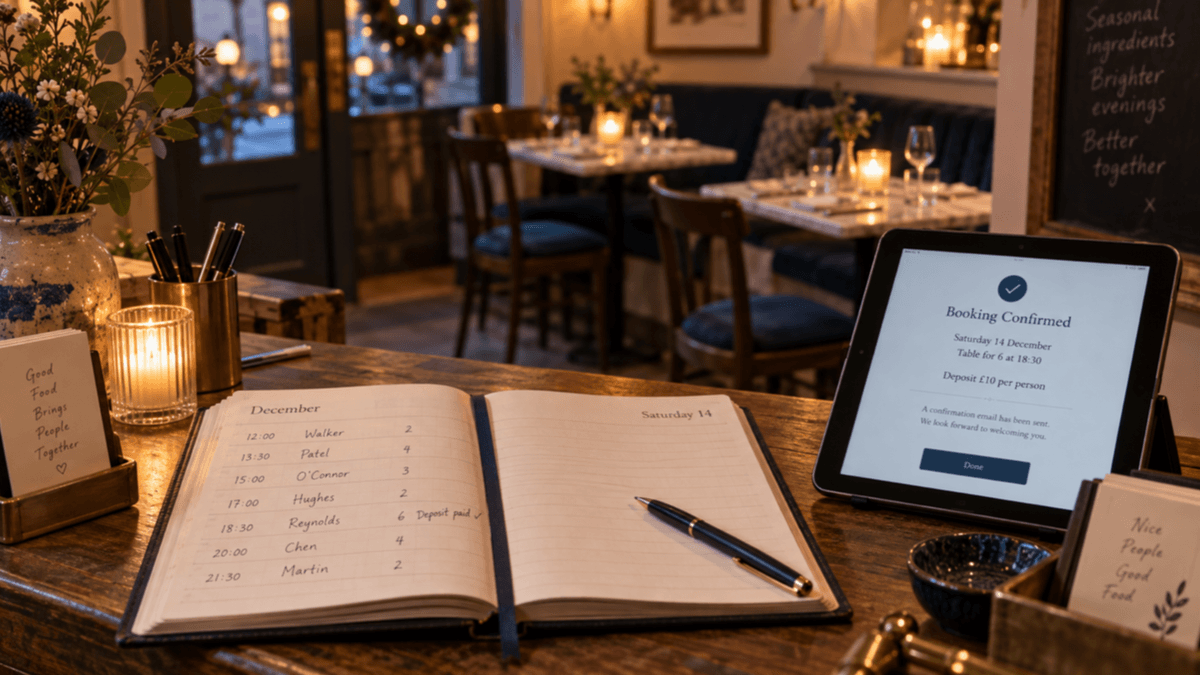
A six-top books for seven o'clock on the second Saturday in December. You hold the table and turn away two walk-in couples. At ten past seven nobody has arrived, at half past the phone goes to voicemail, and by quarter to eight you reset it for nobody.
In July we said to set the deposit policy while it is still warm outside. This is the post that writes it.
What a no-show actually takes off you
Three losses, and most people count one.
- The covers. Six people who spent nothing.
- The prep. Small on an à la carte night. Nearly everything on a pre-ordered set menu, where the food is bought and portioned before anyone sits down.
- The booking you turned away. The expensive one, and invisible: you never learn what those two couples would have spent.
That third loss is why December is not a wet Tuesday. Every extra cover at peak is close to pure margin, the argument behind table turn and covers per seat: rent paid, staff rostered, lights on. A cover lost at seven never comes back.
Work the number out before you pick it
Most people pick a round figure that sounds reasonable. The Competition and Markets Authority's guidance on unfair terms names three deductions a fair charge should reflect: what you save by not supplying, what you recover by reselling the table, and the benefit of being paid early.
Conventions first, all illustrative. Menu prices include VAT, so every loss is worked ex VAT: eat-in is standard rated at 20%, so gross divided by 1.2 gives net. Cost of sales runs at 32%, inside the 30% to 36% brunch and full-service band in our prime cost guide and level with the 32.1% its worked week lands on.
Case A: an ordinary six-top, à la carte
At £32 a head including VAT, six heads is £192.00. Net of VAT: 192.00 / 1.2 = £160.00. Cost of sales you never bought: 160.00 x 0.32 = £51.20. Contribution lost: 160.00 - 51.20 = £108.80.
At peak you might re-seat a six-top half the time, so deduct 50% for the table you refill: 108.80 x 0.50 = £54.40 recovered, and 108.80 - 54.40 = £54.40 is the genuine pre-estimate of loss, or £9.07 a head. The third deduction, being paid early, is pennies here. Note it rather than pretend it is off the list.
Now the sum nobody runs. A £10 a head charge is VAT-inclusive money on a standard-rated supply: 10.00 / 1.2 = £8.33 a head of real protection, recovering 91.9% of a £54.40 loss.
Case B: the same table on a festive set menu
At £42 a head, six heads is £252.00, or £210.00 net. Cost of sales at 32% is £67.20, but you only save what you have not committed: the food is bought and portioned, so call it 20%. 67.20 x 0.20 = £13.44, so the loss before mitigation is 210.00 - 13.44 = £196.56.
A fixed sitting is hard to resell at two hours' notice, so deduct only 20%: 196.56 x 0.20 = £39.31 recovered. Pre-estimate of loss: 196.56 - 39.31 = £157.25, or £26.21 a head. A £20 deposit recovers £100.00 net, 63.6% of that. Even £25 recovers only 79.5%.
Nothing like the £12 average spend in the table turn post, but a booked evening sitting is not a lunch cover. Nor does the 25% to 50% band from the Christmas pre-order book carry across.
Deposit, or card on file?
Be honest about what a card hold is. ResDiary's own Stripe FAQ describes its system: the card is tokenised and charged later as a merchant-initiated transaction, not money set aside. The bank can reject that charge, and because no-shows are unlikely to reauthorise, "this money will probably be lost". A card on file changes behaviour; it does not guarantee payment. Read your own platform's wording rather than assume a hold means held funds.
Square Appointments publishes the most specific version. Turn on its no-show policy and the client must add a card to book, the card is kept for that single appointment rather than saved on file, and a cancellation fee can be charged for up to 14 days afterwards. It needs a paid Appointments tier, and it is an appointments product, not a table-reservation system.
Money taken at booking removes the question of whether a bank will approve a charge later. It does not make the money untouchable: a slice is HMRC's from the day it lands, and an unfair term is still unfair.
The VAT falls due the moment the money lands
If you are VAT registered, taking payment before the meal creates a tax point on the day it arrives: declare the VAT when you receive the deposit or issue the invoice, whichever is first.
Eat-in food and drink is always standard rated, so a booking deposit carries 20% inside it. Most of the pre-order book is the opposite: a Christmas cake sold cold to take away is zero rated. Do not carry the bakery rule across; check the four VAT buckets.
Say 25 festive six-tops each pay £20 a head in October: £120 a booking, £3,000 across the book. The VAT element is 3,000.00 / 6 = £500.00, due on the return that covers October. Only £2,500 of that cash is yours.
Wording that survives a complaint
Under the Consumer Rights Act 2015 an unfair term is simply not binding on the consumer. The risk that bites a café is commercial, not regulatory: a charge you cannot recover and a chargeback that sticks. The CMA can fine for unfair terms now, but it is not coming for your booking policy.
A no-show charge sits on the Act's grey list: terms making a consumer who does not perform pay a disproportionately high sum, and terms letting you keep money with no equivalent remedy if you cancel. Listed means it stays open to a fairness assessment however clearly you write it. Nobody gets to call it watertight.
Five things make it hold:
- State the sum in money and use a dated sliding scale. A Scottish court upheld a 75% cancellation charge on a round-the-world yacht race, partly because it was an ascending table rather than small print. The CMA cites that case with its caveat: the judge treated it as unlike an ordinary consumer contract. Presentation helps; it will not carry a number your loss does not support.
- Frame it as a proportionate contribution to costs. The CMA's example of a term unlikely to be fair is a 30% fee asserting "this does not represent a penalty". Saying so does not make it so.
- Give it before the customer is bound. Burying a significant term in the documents is not enough.
- Repeat it on the confirmation. For an online or phone booking you must confirm on a durable medium before service starts, spelling out the fee and the refunds.
- Make it easy to avoid, with a genuine free-cancellation window and a reminder. "The consumer can easily avoid the sanction" is one of the CMA's fairness tests.
A starting point for your own adviser, adapted from the CMA's "more likely to be fair" example:
Tables of six or more are held with £10 per person, taken when you book. If you come, it comes off your bill. Cancel more than seven days before and we refund in full. Between seven days and 48 hours, we keep half. Inside 48 hours, or if you do not arrive, we keep it as a proportionate contribution towards the food, staff and table committed to your booking. If we cancel, we refund the same amount in full. Your table is booked for a specific date and time, so the 14-day right to cancel that applies to most online purchases does not apply.
Take the if-we-cancel limb to your adviser: the grey list contemplates compensation of an equivalent amount when you cancel, not just a refund.
Enforce it on the first one, not the fifth
Take the card details at booking. Send the confirmation that says the number out loud. Send the reminder a day before the free-cancellation cut-off, not on it, with a one-tap cancel link: 72 hours against a 48-hour cut-off gives a real chance to cancel free, which is kinder and holds up better if the charge is challenged. Ring the table at the cut-off. And charge the first no-show of the season: a policy enforced in week three is one the team believes in by week five.
On Square's published UK rates, £3,000 of deposits keyed in or charged from a card on file at 2.5% costs £75.00 on UK cards. Taken online at 1.4% + 25p a card it is £48.25. On one £120 deposit a UK card costs £1.93 and a non-UK card at 2.5% + 25p costs £3.25, and that £1.32 gap is the whole of the non-UK card fee problem.
Keep discretion for the genuinely ill. Do not advertise it.
Write it in September
I open the Christmas pre-order book in the last week of September, and I have said before that it feels absurd with the sun still out. The booking policy belongs in the same week.
This week:
- Pick the party size that triggers a policy. Six suits most rooms.
- Run both sums on your own average spend, à la carte and set menu.
- Write the sliding scale with real dates and a free-cancellation window.
- Get it into the booking flow and the confirmation, not the website footer.
- Tell the team the script for the awkward call.
Sort the rota behind it too: holding a policy in December needs people on the floor, a December leave problem of its own.
A no-show costs you the covers, the prep and the table you turned away. A policy costs you an afternoon. December is not the month to invent one.
Ed O'Brien has run Hunters Cake Company for 17 years across cafés in Witney, Burford, and a bakery in Carterton, Oxfordshire. He's building Brikly - modular tools that give independent café owners the same data the big chains have, without the big chain price tag.