
Variable-weight invoices: when the price per kilo is fixed but the bill isn't
Same ham, same supplier, same price per kilo. One Tuesday the invoice line says £36.64. The next Tuesday it says £45.70, a rise of 24.7% that isn't a rise at all. The joint was bigger.
A week later the line reads £40.90, less than the week before and less than the first joint's £42.18, and that's the one with the price rise in it. The rate went from £13.52 to £14.30 a kilo, 5.8%, and a smaller joint hid it.
That's catch weight: goods billed on what each piece actually weighed, at a fixed price per kilo. Here's how it shows up on the paperwork, four deliveries of a whole cooked ham for a hypothetical café, what that ham should cost per sandwich, how to catch a short-weight line at the back door, and what weights and measures law does and doesn't say about it.
The weights and measures law quoted here applies in England, Scotland and Wales. Northern Ireland has its own, including the Weights and Measures (Packaged Goods) Regulations (Northern Ireland) 2011.
Where a price isn't linked to a source it's my illustrative UK trade figure, ex VAT, at November 2026 levels. The Brakes prices linked below are its logged-out prices, which it says reflect an average customer discount, so your account price may differ. Use your own invoices.
What catch weight looks like on paper
Most of what a café buys comes in a fixed pack: a 2kg tub, a 454g pack of sliced ham, a 16kg sack. You pay per pack, and every pack is meant to hold the same.
Catch-weight goods are cut, cooked or formed as whole pieces, so no two weigh the same. Whole cooked hams and gammon joints, cheese blocks and wheels, turkey crowns, sides of salmon, meat joints and some fruit and veg are sold this way. The product has a rough size, the supplier weighs the piece you get, and you pay that weight at the rate per kilo.
You can see it on a wholesaler's website. Brakes lists a cooked ham joint as "1 x 2.5-3.5kg" at £13.52 a kilo, with a price of £40.56 marked "est.". That's 3kg, the middle of the range, at the rate. On the same page a 5.75kg ham joint has a fixed price with no "est." beside it.
The estimated price is what an average piece would cost. The invoice tells you what yours did:
| Description | Qty | Weight | Price | Line total |
|---|---|---|---|---|
| Cooked ham joint, approx 2.5-3.5kg | 1 | 3.12kg | £13.52/kg | £42.18 |
So a catch-weight line carries three sizes and one price. The size in the description is a range or a guess. The weight on the piece's own label is what the packer weighed. The weight on the invoice is what you're being charged for, and it should match the label. Some delivery notes print the weight; some just say "1". Only the rate per kilo tells you the price.
Four weeks of the same ham
An illustrative, hypothetical café buys one cooked ham joint a week for its sandwiches and toasties. The supplier's rate holds at £13.52 a kilo for three weeks, then goes up.
| Delivery | Weight | Rate per kg | Line total | Bill vs last week | Rate vs last week | Line total / 3kg |
|---|---|---|---|---|---|---|
| Week 1 | 3.12kg | £13.52 | £42.18 | £14.06 | ||
| Week 2 | 2.71kg | £13.52 | £36.64 | -13.1% | No change | £12.21 |
| Week 3 | 3.38kg | £13.52 | £45.70 | +24.7% | No change | £15.23 |
| Week 4 | 2.86kg | £14.30 | £40.90 | -10.5% | +5.8% | £13.63 |
Line totals are rounded to the penny. The last column is what you get if you divide the bill by the 3kg the description suggests, which is the mistake I'll come to first. Three things go wrong with lines like these.
Mistake 1: costing the recipe from the piece
Save the ham as "one joint, 3kg" at whatever the last invoice said, and the cost moves every week while the price doesn't. On that last column, the ham looked like it went from £12.21 a kilo to £15.23 between weeks 2 and 3. Nothing changed but the weight.
At the yield and portion worked out below, that's 81.4p of ham in a week 2 sandwich and 101.5p in a week 3 one. The true figure was 90.1p both weeks. A recipe costed on the size in the description is costed on a guess, and so is one costed on the "est." price.
Mistake 2: reading the bill instead of the rate
Watch the line totals and you'll ring about week 3, the 24.7% jump, and wave week 4 through because it's cheaper. Both are wrong. Week 3 was more ham. Week 4 was a 78p a kilo rise, and its bill was still £1.28 less than week 1's.
At about 3kg a week, 156kg a year, 78p a kilo is £121.68 a year. No line total went up to warn you.
Mistake 3: paying for weight that never arrived
The rate can be right and the weight wrong. That's a goods-in problem, and it has its own section below.
What the ham costs in a sandwich
The rate per kilo isn't the cost per sandwich, because not all of a joint reaches the bread. There are two ends, a layer of fat and jelly some people take off, and the last piece the slicer can't safely take. I've used 90% as an illustrative yield for a 3kg boneless joint, so about 300g of ends and trim. Your joint, your slicer and your fussiness will differ, so measure it: weigh the joint, slice it the way you do on a busy day, and weigh what goes into the tubs. It's the same idea as the cooking loss that recipe cards miss, with a knife instead of an oven.
- Before the rise: £13.52 / 0.9 = £15.02 a usable kilo. A 60g portion is 90.1p.
- After the rise: £14.30 / 0.9 = £15.89 a usable kilo. A 60g portion is 95.3p.
The rise costs 5.2p a sandwich. On the card, the line should say 66.7g of ham as bought (60g / 0.9), at the rate per kilo. That costs 90.1p at £13.52, the same answer, and it keeps the yield where you can see it.
The joint's size changes how many sandwiches you get, not what each one costs. At 90%, the 2.71kg joint makes 40 sandwiches with a bit over, and the 3.38kg one makes 50. That's how catch weight is meant to work, and it's why you cost the ham per kilo and the sandwich per gram.
Short weight: billed for 2.52kg, delivered 2.33kg
Catch weight also opens a gap the rate can't show: the weight on the invoice not matching the piece in the crate.
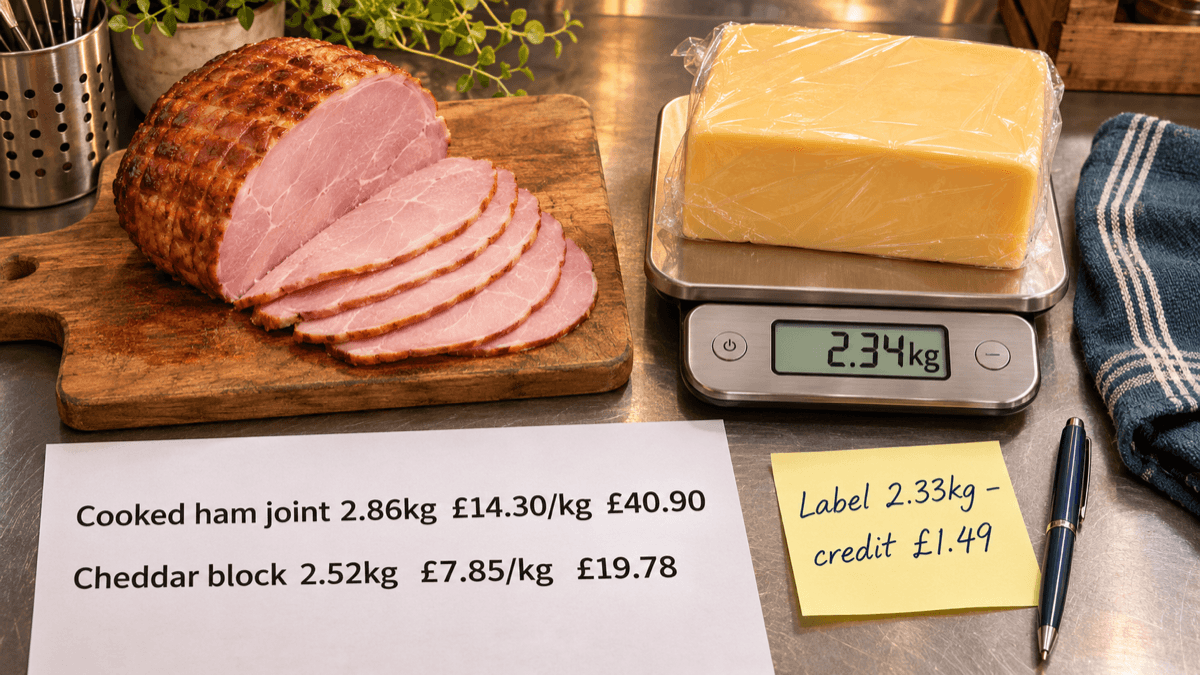
Same café, a block of mild cheddar described as "approx 2.5kg", at £7.85 a kilo. The invoice says 2.52kg, £19.78. The label on the block says 2.33kg. On the scale, still in its wrap, it reads 2.34kg, and the wrap weighs, say, 10g, so 2.33kg of cheese. The label is right and the invoice isn't.
- Billed: 2.52kg x £7.85 = £19.78
- Delivered: 2.33kg x £7.85 = £18.29
- Owed back: 190g, £1.49
£1.49 is the kind of gap nobody chases. But a supplier's system that keys the wrong weight once may do it every week, and on a weekly block that's £77.48 a year (£1.49 x 52). The other direction happens too: the label and invoice agree and the scale is well short. Either way, this is what the back door check is for.
At the back door
The goods-in check covers counting, temperatures and signing short. For anything sold by weight, add four things:
- Weigh it on arrival, in its wrap, before it goes in the fridge. Weigh an empty wrap or vacuum bag of the same kind once and take that off every time.
- Read three numbers: the label on the piece, the weight on the delivery note or invoice, and your scale. They should agree to within a few grams.
- Write any gap on the delivery note before you sign, something like "Cheddar block: label 2.33kg, invoiced 2.52kg", and get the driver to initial it.
- Photograph the label next to the scale. The label goes in the bin when the block is opened, and the photo is your evidence.
Then claim it the way you'd claim any short, with the photo and the annotated note, and log it until the credit arrives. The method is in claiming credit notes from suppliers.
Don't ring about 10g on a 3kg joint. Wraps, moisture and your own scale account for that. 190g is worth the call. You need a bench scale that goes to at least 5kg and reads in 5g steps or finer. It needn't be trade-approved to start a conversation, but it does have to be right.
What the law says, and what it doesn't
Fixed packs: the average system
Packs made up to a fixed quantity come under the Weights and Measures (Packaged Goods) Regulations 2006, which apply to "packages intended for sale in constant unit nominal quantities" between 5g and 25kg. The GOV.UK guidance, published by the Office for Product Safety and Standards, sets out the three packers' rules:
- "The contents of the packages must not be less on average than the nominal quantity"
- The proportion short by more than the "tolerable negative error" should be "less than a specified level"
- "No package should be short by twice the tolerable negative error"
So a fixed pack can legitimately weigh a little under what it says, as long as the batch averages out. GOV.UK's packaged goods page puts the tolerable negative error at 1.5% for packs from 1,000g to 10,000g. On a fixed 2.5kg pack that's 37.5g, and no pack should be more than 75g short.
The ℮ mark you see beside the weight on many packs is, in the guidance's words, "a declaration by the packer that the contents comply with the average system". It's voluntary: "There is no requirement for packages to be labelled with the '℮' mark."
One more limit. Regulation 3(4) says the Regulations don't apply to packages without the ℮ mark whose contents are "intended solely for use in, or in connection with, a process or treatment in the course of a trade or business". Whether that catches a particular catering pack is a question for trading standards, not something to argue with the driver.
Catch weight: what's on the label
The average system isn't how catch-weight goods work. Trading standards' Business Companion guidance on packaged goods says the rules "do not apply to 'catchweight' items where the quantities within packages vary", and gives as its example prepacked cheese where the price the customer pays depends on each piece's weight. It's guidance written for packs sold to shoppers, so read it as the shop-shelf rules rather than a statement of what your wholesaler owes you.
Where each package is weighed individually, the same guidance says the goods are, "because of other weights and measures legislation, required to contain at least the quantity stated", and that the minimum net quantity "must be determined using prescribed equipment". Its guide to weighing and measuring meat says prepacked meat "must be marked with the net weight of the product in metric units", and names ham among the products it covers. That guide says it's "intended for traditional businesses supplying products at the request of customers", so it's written with shop sales in mind rather than wholesale.
Short weight and who enforces it
Section 28 of the Weights and Measures Act 1985 makes it an offence for anyone "selling or purporting to sell any goods by weight" to deliver less than the quantity they claimed to sell, or less than the price charged should buy. It's subject to the defences in sections 33 to 37 of the Act. On the GOV.UK guidance, "Enforcement of the law is carried out by Local Authority Trading Standards."
That's criminal law, and trading standards enforce it. Your own position as a buyer sits in the general law of sale. Under section 30 of the Sale of Goods Act 1979, a buyer sent less than the contract quantity who accepts it "must pay for them at the contract rate", which on a line priced by the kilo would point to paying for 2.33kg, not 2.52kg. The section is "subject to any usage of trade, special agreement, or course of dealing", so your account terms come first. In practice your £1.49 comes back through those terms, the note you wrote on the delivery and a credit note, which is how it gets settled cleanly. If a supplier's weights are wrong again and again and they won't put it right, you can raise it with your local trading standards service. Just don't expect them to collect your credit.
Compare suppliers per kilo, then per usable kilo
A catch-weight quote and a fixed-pack quote can't be compared by the pack. Here are three ways to buy ham for the same 60g portion:
| Option | Pack | Pack price | Per kg | Yield | Per usable kg | 60g portion |
|---|---|---|---|---|---|---|
| A: catch-weight joint (Brakes) | approx 2.5-3.5kg | £40.56 est. | £13.52 | 90% | £15.02 | 90.1p |
| B: fixed joint, second supplier (illustrative) | 2.5kg | £35.50 | £14.20 | 90% | £15.78 | 94.7p |
| C: sliced ham (Brakes) | 454g | £7.21 | £15.88 | 100% | £15.88 | 95.3p |
By the pack, B looks £5.06 cheaper than A. By the kilo it's 68p dearer. That's the like-for-like per-unit comparison in one line, and catch weight is where people get it backwards, because the estimated price looks like a pack price.
Then add the slicing: say 15 minutes for a 3kg joint, my estimate, at the house rate of 26.5p a minute. That's £3.975, or 8.8p on each of its 45 portions at 90%, taking A to 99.0p and B to 103.5p against 95.3p for the sliced ham.
On these numbers the joint wins on ingredients and loses once you count the time, unless you slice a 3kg joint in under about 9 minutes. Your times and prices will differ, and you may prefer a carved joint anyway. Make the comparison per usable kilo, with the time in, before you switch.
Shrinkflation's cousin
A catch-weight line can't shrink the way a fixed pack does, because you pay for every gram. But the pack-size cuts hiding in your invoices have relatives here, and they all work by changing what you get per kilo without touching the rate.
- The pieces get smaller, or the range moves. Joints that used to arrive at 3.2kg start arriving at 2.6kg, or "approx 2.5-3.5kg" becomes "approx 2.3-3.3kg". The rate holds and the bills look lower, but much of the trim is the same two ends whatever the size. If it's a fixed 300g, a 2.5kg joint yields 88%, not 90%, and the usable kilo goes from £15.02 to £15.36: 92.2p a 60g portion instead of 90.1p.
- The product changes inside the same name. A new ham can carry more water at the same rate per kilo. The US Department of Agriculture's school-meals Food Buying Guide counts a boneless cooked ham "with natural juices" as 0.90lb of cooked lean meat per pound bought, and a "water added" ham as 0.82lb. Those are US figures for crediting school meals, not a slicing test, but the direction is the point: less meat in every kilo you pay for. When a joint looks or slices differently, read the ingredients on its label against the old one.
Keep the rate, and the weights
One sheet for everything you buy by weight: date, supplier, product, label weight, invoice weight, your weight, rate per kilo and line total. The rate column is the price history. The three weight columns are your goods-in record. A rate that moves without a letter is a phone call; a weight gap is a credit claim.
For the recipe, follow the same rule as the guide to which invoice price goes in the recipe: cost on the latest rate you were actually charged, keep the earlier ones, and read the direction. Never cost from a line total or an estimated price.
CostingBrik's docs describe catch-weight lines handled the same way: on a line priced per kilo, the delivered weight stays as the quantity and the rate per kilo stays as the unit price, and on deli lines the piece size in the product name stays as the pack, so a case of ten 2.5kg salamis delivered at 23.5kg in all isn't recorded as one 23.5kg item. Matched prices then flow through to the recipes that use the ingredient.
This week
- Pull the last four invoices for every line you buy by weight: ham, cheese, meat joints, fish.
- Write down the rate per kilo for each delivery, not the line total, and circle any rate that moved.
- Check what each recipe card is costed from. If it's a piece price divided by the weight in the description, fix it.
- Measure the yield on your next joint or block, and put it on the card.
- Put a scale by the back door that goes to at least 5kg, and check it against a known weight.
- Weigh every catch-weight item on arrival and compare the label, the delivery note and the invoice. Write any gap on the note before you sign.
- Claim the credit for every gap, with the photo, and log it until it's paid.
- Compare suppliers per usable kilo, slicing time included, before you switch.
The free recipe costing calculator will turn a rate and a yield into a cost per portion in a couple of minutes. The bill on a catch-weight line is meant to change every week. The rate isn't, and that's the number to watch.
Ed O'Brien has run Hunters Cake Company for 17 years across cafés in Witney, Burford, and a bakery in Carterton, Oxfordshire. He's building Brikly - modular tools that give independent café owners the same data the big chains have, without the big chain price tag.