
Costing your Christmas drinks before the festive menu goes up
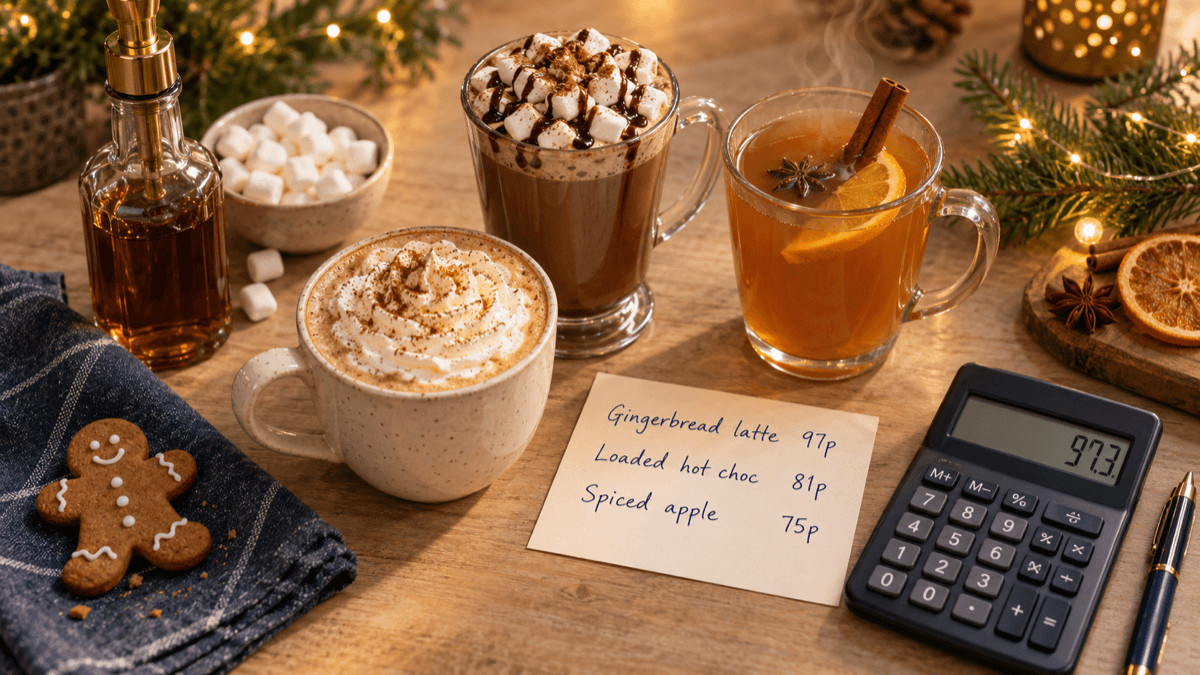
Somewhere around the third week of November the spiced latte goes quiet and the festive board goes up. Then the first busy Saturday arrives, the queue reaches the door, and the new starter finishes every gingerbread latte with a third pump and a swirl of cream that would not look out of place on a trifle.
Nobody has done anything wrong; they have done what customers like, at speed. But on the numbers below, a gingerbread latte or loaded hot chocolate built to spec earns around 47p to 51p more cash than the plain drink the customer would otherwise buy, and a rushed build quietly gives back between two fifths and just over half of it.
In August I costed a spiced latte for the autumn menu switch; this picks up where the spiced line fades. It is also the job planning Christmas in July set: cost the festive menu before you print it, not after.
The inputs, and the one VAT rule
Every price here is an illustrative trade price, ex VAT, checked in early October 2026, with espresso and milk matching my recent cup size and packaging posts. At £1.05 a litre the milk is at the keen end; at £1.28 a 12oz latte's milk costs about 6p more, which trims the coffee and chocolate gross profits below but barely moves their festive uplift, because the plain drinks carry milk too. It does flatter the dairy-free spiced apple against a hot chocolate, by about 7p. Use your own last invoice for every line.
| Input | Illustrative trade price, ex VAT | Per serve |
|---|---|---|
| Espresso beans | £22.00/kg | 18g double = 39.6p |
| Whole milk | £1.05/litre | 260ml = 27.3p, 280ml = 29.4p, 300ml = 31.5p |
| Drinking chocolate powder | £8.50/kg | 30g = 25.5p |
| Festive syrup | £9.50/litre | 10ml pump = 9.5p |
| Aerosol whipped cream | £4.15 per 500g can | 12.5g = 10.4p |
| Mini marshmallows | £7.00/kg | 10g = 7.0p |
| Chocolate sauce | £8.99/kg | 10g = 9.0p |
| Cloudy apple juice | £2.00/litre | 300ml = 60.0p |
| Mulling spice | £21.49/kg | 4g = 8.6p |
| Spiced apple concentrate | £7.00/litre | 30ml = 21.0p |
| Short cinnamon stick | my estimate | 6.0p |
| Spice dusting | my estimate | 1.0p |
The £9.50 syrup is the seasonal price the autumn post used; budget gingerbread syrups list nearer £7 a litre and premium brands about £12.40.
The VAT rule is short. HMRC's VAT Notice 709/1 says at section 4.1: "Hot takeaway drinks are standard-rated." Test 1 in section 4.3 lists "tea, coffee, chocolate and other hot drinks", which covers a hot spiced apple too, and eat-in is standard-rated catering anyway. So every drink here is 20% VAT, in or out: divide the menu price by 1.2, and a £4.50 drink is £3.75 of turnover.
The gingerbread latte
The comparison is the plain 12oz latte the customer would otherwise buy: 39.6p of espresso and 29.4p of milk, so 69.0p. At £3.60 you keep £3.00 and make £2.31, which is 77.0%.
The gingerbread version gets 260ml of milk, because syrup and cream take up room. Illustrative, eat-in, at £4.50:
| 12oz, eat-in | On spec | Rush build |
|---|---|---|
| Espresso, 18g | 39.6p | 39.6p |
| Milk, 260ml | 27.3p | 27.3p |
| Gingerbread syrup | 2 pumps, 19.0p | 3 pumps, 28.5p |
| Whipped cream | 12.5g, 10.4p | 25g, 20.8p |
| Spice dusting | 1.0p | 1.0p |
| Cost | 97.3p | 117.2p |
| Net price (£4.50 ÷ 1.2) | £3.75 | £3.75 |
| Gross profit | £2.78 | £2.58 |
| GP% | 74.1% | 68.7% |
| Extra cash vs a plain latte | +46.7p | +26.8p |
On spec, the festive version banks 46.7p more than a plain latte. Built the way it gets built at eleven on a December Saturday, with a third pump and a swirl twice the size, it banks 26.8p more. The extra pump (9.5p) and extra cream (10.4p) come to 19.9p, about 43% of the uplift, handed back on every cup. On the latte the syrup is still the bigger line; the leak is the extra pump and the generous hand together.
The loaded hot chocolate: the toppings are the drink
The plain 12oz hot chocolate is 30g of powder at 25.5p and 300ml of milk at 31.5p, so 57.0p. At £3.60 it makes £2.43, which is 81.0%. The loaded version gets 280ml of milk to leave room on top. Illustrative, eat-in, at £4.50:
| 12oz, eat-in | On spec | Rush build |
|---|---|---|
| Drinking chocolate, 30g | 25.5p | 25.5p |
| Milk, 280ml | 29.4p | 29.4p |
| Whipped cream | 12.5g, 10.4p | 25g, 20.8p |
| Mini marshmallows | 10g, 7.0p | 20g, 14.0p |
| Chocolate sauce | 10g, 9.0p | 20g, 18.0p |
| Toppings subtotal | 26.4p | 52.8p |
| Cost | 81.3p | 107.7p |
| Net price (£4.50 ÷ 1.2) | £3.75 | £3.75 |
| Gross profit | £2.94 | £2.67 |
| GP% | 78.3% | 71.3% |
| Extra cash vs a plain hot chocolate | +50.7p | +24.3p |
Here the toppings really are the drink. On spec they cost 26.4p, more than the 25.5p of chocolate underneath. In a rush they cost 52.8p, almost as much as the powder and milk together at 54.9p, and the uplift falls from 50.7p to 24.3p: doubling the toppings hands back 26.4p, just over half.
The base matters too. Made on flakes, at roughly £17 to £36 a kilo and 30g to 40g a cup, the chocolate alone is 51p to £1.44, and one topping is plenty.
Cocoa has swung hard this year: ICE New York cocoa was trading at around $5,600 to $5,700 a tonne on 2 October, according to Trading Economics, down about 8% on a year earlier, and the December contract's 52-week range runs from roughly $2,850 to $6,820. As the cocoa post in May put it, your supplier's price is sticky on the way up and reluctant on the way down, so cost the powder and sauce from this autumn's invoice.
The spiced apple: two very different drinks
This one is for the people who do not want coffee, and it can go two ways. Illustrative, eat-in, at £3.80, against the plain hot chocolate a non-coffee drinker might otherwise order:
| 12oz, eat-in | Juice and spice | Concentrate |
|---|---|---|
| Cloudy apple juice, 300ml | 60.0p | nil |
| Mulling spice, 4g | 8.6p | nil |
| Concentrate, 30ml plus 270ml hot water | nil | 21.0p |
| Short cinnamon stick | 6.0p | 6.0p |
| Cost | 74.6p | 27.0p |
| Net price (£3.80 ÷ 1.2) | 316.7p | 316.7p |
| Gross profit | £2.42 | £2.90 |
| GP% | 76.4% | 91.5% |
| Versus a plain hot chocolate (243.0p) | 0.9p less | +46.7p |
The juice route is a lovely drink that, on these numbers, earns no festive premium at all. A catering apple juice at around £13.80 plus VAT for 12 litres, £1.15 a litre, cuts the cost to 49.1p and lifts gross profit to 267.6p, or £2.68, which is 24.6p ahead of the hot chocolate.
The concentrate route is a different animal. One ready-made spiced apple syrup lists at about £7 a litre, treated here as ex VAT, and is served "1 part syrup to 9 parts hot water", per the supplier's product page. So 30ml makes a 300ml drink for 21p: 91.5%, the best margin on the board, and better still if that price includes VAT. The page also notes the flavour "does not mix with milk", so taste both side by side before you choose.
One garnish, not two: an orange slice is 4p or 5p if an orange at 35p to 40p gives you eight (my estimate, like the 6p stick). And keep it non-alcoholic, because mulled wine brings licensing in.
Why toppings leak, and how to stop it
Nobody under-pours cream. A swirl is judged by how it looks, and the can makes it effortless. One catering can's label says it "Contains an average of 40 servings (1 serving = 12.5g)". A swirl that reaches the rim and carries on is easily twice that. Marshmallows go in by the handful; sauce goes on until it looks generous.
Three things fix most of it.
- One build card per drink, with numbers instead of adjectives. "Two pumps", not "a couple". "One swirl, level with the rim", not "some cream". A marshmallow scoop that holds 10g, and a sauce zig-zag you have weighed.
- Count, do not guess. Weigh three swirls, three scoops and three drizzles at service speed and average them. Then pump ten shots into a measuring jug: many 1-litre pumps give 10ml, but one gingerbread syrup's pump gives "approximately 125 shots" a bottle, nearer 8ml, which changes both the cost and the order.
- One good topping, not three. In August I said autumn wanted "a proper hot chocolate with one good topping rather than three mediocre ones", and these numbers agree. The loaded hot chocolate is a named, priced drink with a spec. Everything else gets cream or marshmallows, not both with sauce on top.
Paid extra or baked in?
The post on pricing modifiers and extras set a simple rule: "any modifier that changes ingredient cost by more than 10p should have a price attached." Cream on spec is 10.4p, just over that line, and sauce at 9p sits just under it.
On the festive drinks, bake it in: a fixed build, one till button, one price, and a clean count for next year's order. The price is attached; it is inside the £4.50.
The leak is the request. "Could I have cream on my latte?" A 40p add-cream button is 33.3p net, which covers a 10.4p swirl with 22.9p to spare, and even a 20.8p rush swirl with 12.5p left. Without a button, it is free cream every time someone asks nicely.
If you would rather run "loaded" as an add-on, do the sum first. A 50p "make it loaded" on a £3.60 hot chocolate takes £4.10, or 341.7p net. On spec that cup costs 81.3p and makes 260.4p, 17.4p more than the plain one's 243.0p, against 50.7p as a named festive drink. Poured in a rush at 107.7p it makes 234.0p: 9.0p less than a plain hot chocolate. An extra priced against the spec only works if the spec is followed.
Takeaway, and the large
Takeaway costs you the cup but not the VAT. Costing packaging per sale put a 13p cup, 5p lid and 3p sleeve at 21p, so take 21p off each gross profit above: the on-spec gingerbread latte drops from £2.78 to £2.57, on unchanged turnover.
The plain takeaway latte carries the same cup and sleeve, so the festive uplift stays at 46.7p, less one thing: a drink with a swirl on top usually needs a domed lid, which costs more than the 5p sip lid. Take the difference off the uplift.
Going large is where festive builds drift. A "bit more of everything" 16oz can eat most of its size step, so cost it as its own build with its own pump count, the way the cup size price ladder does for a hot chocolate.
Ordering for a five-week window
The festive line runs from roughly the third week of November to Christmas, about five weeks. Syrup is what you will over-order, because running out in week three feels worse than a spare. So order to a number:
Bottles = drinks x pumps x your pump size (usually 10ml) ÷ about 950ml usable.
A litre is nominally 100 pumps at 10ml, but the dip tube never quite reaches the last of it, so call it 95, which also nudges the true cost of a pump from 9.5p to 10p. Say last year's till shows 300 gingerbread lattes across the window: 300 x 2 x 10ml = 6,000ml, and 6,000 ÷ 950 = 6.3 bottles. Order six and top up if it sells, or seven if your supplier's festive cut-off makes a top-up risky.
That needs each festive drink on its own till button rather than "hot chocolate plus an extra". No count this year? Set the buttons up now and order from an honest guess.
Opened bottles are the catch. Makers and sellers quote roughly one to two months once a pump goes in: one major syrup maker's FAQ says "the shelf life when using a pump or pour spout will be 30-60 days", and a UK coffee roaster that sells syrups says 1 to 2 months. Some budget brands print a longer figure, so go by your label, but a pumped bottle opened in late November is close to its date by mid-January.
- Date every bottle when you open it, in marker on the label.
- Open one bottle per flavour at a time, and cap or cover the pump overnight.
- Stop opening new bottles about ten days before the line comes off, and let the last one run down.
Unopened leftovers are not a waste problem. The same roaster notes that "When unopened, syrups usually last between 12 and 36 months", so check the best-before and box them for next November. They are cash sitting on a shelf, which is the real reason to order to a number. Opened ones want using up in the first week of January.
The build card
The summary to write up, laminate and put behind the bar. The cost columns are for you; whether the team sees them is your call, though in my experience a barista who knows a swirl costs 10p pours 10p swirls.
| Drink, 12oz | Base | Syrup | Toppings | Garnish | Cost | Price | GP |
|---|---|---|---|---|---|---|---|
| Gingerbread latte | Double shot, 260ml milk | 2 pumps | Cream, 1 swirl (12.5g) | Spice dusting | 97.3p | £4.50 | £2.78 |
| Loaded hot chocolate | 30g powder, 280ml milk | None | Cream 12.5g, marshmallows 10g, sauce 10g | None | 81.3p | £4.50 | £2.94 |
| Spiced apple, juice | 300ml cloudy juice, 4g spice | None | None | Short cinnamon stick | 74.6p | £3.80 | £2.42 |
| Spiced apple, concentrate | 30ml concentrate, 270ml hot water | None | None | Short cinnamon stick | 27.0p | £3.80 | £2.90 |
All illustrative, eat-in and ex VAT. Take 21p off each GP for takeaway.
This week
- Cost the three builds at your own invoice prices, on spec and as actually poured.
- Weigh three swirls, three scoops and three drizzles, and pump ten shots into a jug.
- Write the build card, laminate it and brief the team before the board goes up.
- Decide baked in or extra for every topping, and put an add-cream button on the till.
- Order syrup to a number: last year's count x pumps x your measured pump size ÷ 950ml.
- Leave a marker by the syrup shelf and date every bottle as it is opened.
The free recipe costing calculator does the per-serve arithmetic without a login. In CostingBrik you can duplicate the house latte into a gingerbread latte, add the festive lines, and tick the cup and lid as Takeaway only to see dine-in and to-go margins side by side. When the next cream or syrup invoice is processed, every festive build is re-costed automatically.
The gingerbread latte and the loaded hot chocolate are worth around 47p to 51p a cup more than the plain versions when the build card is followed, and roughly half that when it is not. The difference is a laminated card and a set of scales.
Ed O'Brien has run Hunters Cake Company for 17 years across cafés in Witney, Burford, and a bakery in Carterton, Oxfordshire. He's building Brikly - modular tools that give independent café owners the same data the big chains have, without the big chain price tag.