
Costing a Christmas hamper: what's really in the £35 box
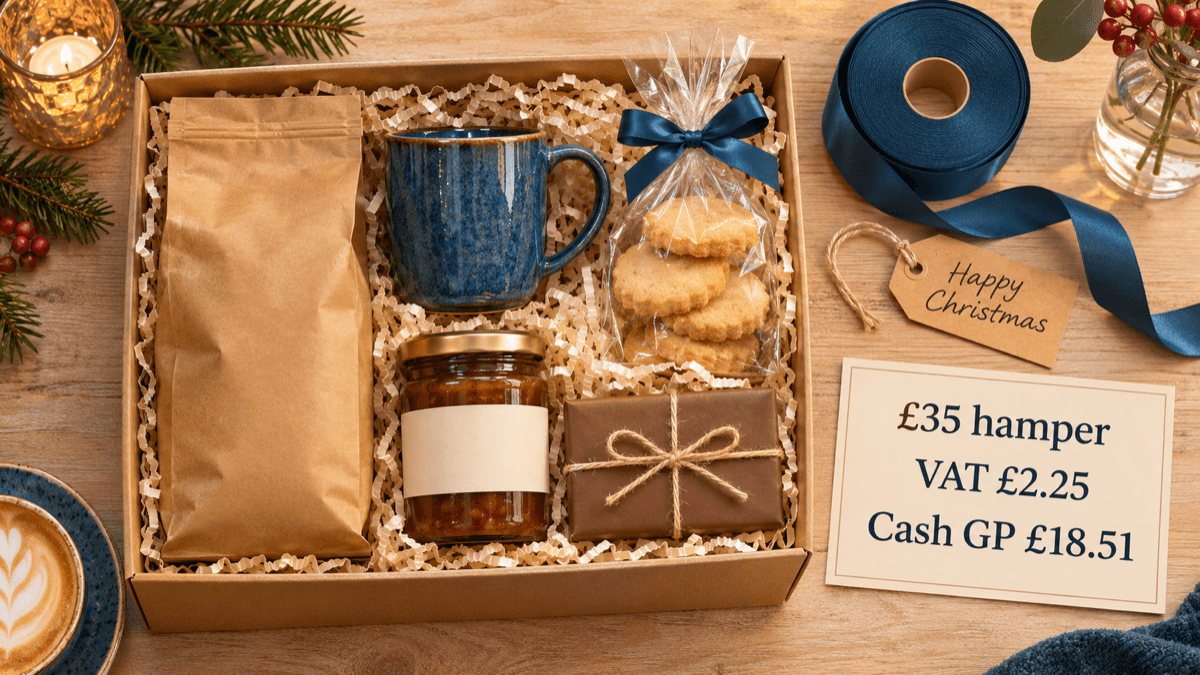
Ring a £35 hamper of coffee beans, a mug, shortbread, chutney and a bar of chocolate on the zero-rated "retail" button, because it's mostly food, and that's £2.25 of VAT not declared on every one. Ring it as standard-rated to be safe and you hand over £5.83: £3.58 a hamper you never owed.
Neither is right. A hamper that mixes food with a mug or a bar of chocolate is a mixed supply, and HMRC expects the price to be split between the rates. Then there's the box, the crinkle paper, the ribbon and six minutes of someone's time, which between them take nearly two-thirds of the £6.50 the hamper charges over its contents.
Here are three hampers for a hypothetical café, costed line by line, with the VAT split HMRC's guidance describes and a test for whether each is worth packing at all.
VAT rules are UK-wide. The allergen guidance quoted is the Food Standards Agency's, which covers England, Wales and Northern Ireland; Scotland's regulator is Food Standards Scotland. The licensing law quoted is the Licensing Act 2003, which covers England and Wales; Scotland and Northern Ireland have their own.
Every cost in this post is my illustrative UK trade figure, ex VAT, at November 2026 levels, for a VAT-registered café that bakes its own; selling prices include VAT where it applies. Use your own invoices. Labour is at 26.5p a minute, kept beside gross profit rather than inside it.
Cost the parts first
A hamper is a recipe made of other recipes. Cost and price every item as a single first, because you'll need both for the VAT split and for the test of whether the hamper earns its keep.
The mince pies and the stollen come straight from costing mince pies, stollen and Christmas cake. The bought-in lines follow the logic in selling retail beans, bakes and merch, where a bag of beans "usually lands lower, often around 40% margin".
| Item, sold singly to take away | VAT | Price | Net | Cost | Labour | GP | Cash GP |
|---|---|---|---|---|---|---|---|
| Box of six mince pies | 0% | £12.00 | 1,200.0p | 233.2p | 132.7p | 80.6% | 966.8p |
| Stollen, 750g loaf | 0% | £14.00 | 1,400.0p | 361.0p | 398.0p | 74.2% | 1,039.0p |
| Shortbread, bag of six fingers | 0% | £4.50 | 450.0p | 73.4p | 145.8p | 83.7% | 376.6p |
| Spiced apple chutney, 220g jar | 0% | £4.50 | 450.0p | 110.7p | 92.8p | 75.4% | 339.3p |
| House coffee beans, 250g bag | 0% | £8.50 | 850.0p | 540.0p | 36.5% | 310.0p | |
| Café mug | 20% | £8.00 | 666.7p | 300.0p | 55.0% | 366.7p | |
| Chocolate bar, 100g | 20% | £3.00 | 250.0p | 150.0p | 40.0% | 100.0p | |
| Red wine, 75cl | 20% | £13.00 | 1,083.3p | 650.0p | 40.0% | 433.3p |
Cost includes each item's own packaging: the mince pie box and ribbon, the stollen's cello bag, the shortbread bag and the chutney jar. The beans are the roaster's retail bag at £5.40. Net price is the price divided by 1.2 for the three standard-rated lines, rounded to 0.1p.
The two bakes not costed before
Shortbread. Plain flour 600g at 70p/kg (42.0p), butter 400g at £7.20/kg (288.0p), caster sugar 200g at £1.10/kg (22.0p), 30g more for dusting (3.3p) and salt (1.0p): 356.3p a batch. It cuts to 40 fingers, so 8.9p each and 53.4p for six. The bag, ribbon and label add 20.0p, making 73.4p. Thirty minutes of hands-on time for the batch is 19.9p a finger, and a minute to bag and label is 26.5p, so six fingers carry 145.8p of labour, about twice their cost.
Chutney. Bramley apples 3.0kg at £1.60/kg (480.0p), brown onions 1.5kg at 90p (135.0p), sultanas 500g at £3.40 (170.0p), light brown sugar 1.0kg at £1.60 (160.0p), cider vinegar 1 litre at £1.80 (180.0p), yellow mustard seed 30g at £8.00/kg (24.0p), ginger and mixed spice 20g at £16.00/kg (32.0p), garlic 50g at £6.40/kg (32.0p) and salt (1.0p): £12.14 a batch. About 7kg goes into the pan and 4.4kg comes out after two hours of simmering, which fills 20 jars at 220g. That's 60.7p a jar of chutney, plus 45p for the jar and lid and 5p for the label: 110.7p. Seventy minutes of peeling, stirring, sterilising and filling is 92.8p a jar.
Both are batches costed once and used as one line in each hamper.
Three hampers, line by line
| £25 bakery box | £35 coffee box | £50 wicker basket | |
|---|---|---|---|
| Contents | Mince pies, shortbread, chutney | Beans, mug, shortbread, chutney, chocolate | Stollen, chutney, beans, wine |
| Contents at single prices | £21.00 | £28.50 | £40.00 |
| Contents cost | 417.3p | 1,174.1p | 1,661.7p |
| Box or basket | 120.0p | 160.0p | 600.0p |
| Crinkle fill, tissue, ribbon | 55.0p | 65.0p | 95.0p |
| Gift tag, contents card | 25.0p | 25.0p | 25.0p |
| Total cost | 617.3p | 1,424.1p | 2,381.7p |
| VAT (worked out below) | £0.00, on my reading | £2.25 | £4.16 |
| Net price | £25.00 | £32.75 | £45.84 |
| GP | 75.3% | 56.5% | 48.0% |
| Cash GP | 1,882.7p | 1,850.9p | 2,202.3p |
| Bake labour, from the singles | 371.3p | 238.6p | 490.8p |
| Packing labour, at 26.5p a minute | 5 min, 132.5p | 6 min, 159.0p | 8 min, 212.0p |
| After labour | 1,378.9p | 1,453.3p | 1,499.5p |
Look at the bottom row first. The £50 hamper takes twice the money of the £25 one and earns £1.21 more after labour. The £25 box is three of your own bakes at 75% to 84% GP with no VAT on any of them. The bigger hampers are filled out with bought-in lines at 36% to 55%, and the wicker basket alone costs £6.00. As with costing packaging per sale, the box, the fill and the ribbon are ingredients.
VAT: a hamper is a mixed supply
What HMRC actually says
HMRC's food products notice, VAT Notice 701/14, paragraph 6.1: "If you supply standard and zero-rated food items (or zero-rated food items and standard-rated non-food items) together for a single price, this is a mixed supply for VAT purposes." The first example on its list is "food hampers", followed by gift packs "like coffee supplied with a mug".
Its internal VAT Food manual at VFOOD2920 is blunter: "Christmas hampers, however, are always regarded as mixed supplies; and VAT must be charged accordingly on the standard-rated elements, which will usually comprise some of the food (confectionery and drinks), as well as the hamper itself."
For the split, the notice points to the VAT guide, Notice 700. Paragraph 8.1.1: "There's no special method of apportionment." Your calculations "must be fair and you must be able to justify them", and section 31 gives two methods, by selling price and by cost.
Which lines carry 20%
- Zero-rated: mince pies, stollen and Christmas cake as cold takeaway cakes and pastry, as the Christmas bakes post sets out, plus plain shortbread, chutney or jam in a plain jar, coffee beans and loose tea. The manual at VFOOD2820 names "jam, marmalade and preserves in a plain jar" as normal packaging that takes the rate of its contents.
- Standard-rated: the mug, chocolate, sweets, fudge and the wine. Watch the shortbread: dip it and it moves, because "Chocolate covered shortbread" is on the notice's standard-rated list.
- The container: paragraph 6.3 says packaging "simply to contain, protect and promote the food" takes the rate of the food. But containers you "must treat" as separate supplies include "tea caddies" and "hampers and picnic baskets (other than simple cardboard cartons)". So the wicker basket is standard-rated, and a plain card box isn't.
- Christmas wrapping: seasonal packaging such as "Christmas overwraps or decorated tins" is "not considered a separate supply unless it falls within one of the categories listed". The tissue and ribbon follow the contents.
A wooden crate or keepsake box isn't named, but the list also includes "any container with a clear and obviously intended after-use". I'd treat a box made to be kept as a basket, not a carton.
The £25 bakery box is the hard case. None of these HMRC pages deals with a hamper whose contents are all zero-rated, and VFOOD2920 pulls the other way: Christmas hampers are "always regarded as mixed supplies", with "the hamper itself" among the standard-rated parts. My reading that the whole £25 is zero-rated rests on one thing, the notice's exception for "simple cardboard cartons". It holds only for a plain card box. A rigid, decorated or keepsake box changes the answer, and I'd zero-rate the box only if your accountant agrees.
Splitting the £35 by selling price
HMRC's guidelines on apportioning a bundle, GfC2, say that "Where each item in a bundle of goods, services, or both, is also sold separately by the business, an apportionment based on the selling price of each item in the bundle is our recommended approach." Every item in the coffee box is on our café's shelf, so that's the method. Following Notice 700's Method 1, rounding money to the penny:
| Step | Sum | Figure |
|---|---|---|
| Hamper price, incl VAT | £35.00 | |
| Zero-rated items at single prices | Shortbread £4.50, chutney £4.50, beans £8.50 | £17.50 |
| Standard-rated items at single prices | Mug £8.00, chocolate £3.00 | £11.00 |
| All items at single prices | £28.50 | |
| Standard-rated share | £11.00 / £28.50 x £35.00 | £13.51 |
| VAT in that share | £13.51 / 6 | £2.25 |
| Zero-rated share | £35.00 - £13.51 | £21.49 |
| Net price | £35.00 - £2.25 | £32.75 |
The hamper sells for more than its parts, and the method spreads that premium across every item in proportion. GfC2 expects you to "evidence the normal selling price of each supply", so these must be prices you actually charge on the shelf.
Splitting the £50 by cost
The wicker basket isn't sold on its own, so there's no selling price for it. GfC2 says that "Where bundled goods or services, or both, are not all sold separately, it may be necessary to base the apportionment on the cost price". It also says that where items are "processed in some way before being bundled", ignoring the processing costs "would increase risk". Your own bakes are processed, so their labour goes in. The card box, fill and packing time serve the whole hamper, and HMRC's costs-based apportionment guidance at VATVAL03900 lets general costs be left out or split in the same proportions, with the same result either way.
Following Notice 700's Method 2(a) for a VAT-inclusive price, with the proportion to four decimal places:
| Step | Sum | Figure |
|---|---|---|
| Zero-rated costs, with bake labour | Stollen 759.0p, chutney 203.5p, beans 540.0p | 1,502.5p |
| Standard-rated costs, ex VAT | Wine 650.0p, basket 600.0p | 1,250.0p |
| Plus VAT on those costs | 1,250.0p x 1.2 | 1,500.0p |
| Total | 1,502.5p + 1,500.0p | 3,002.5p |
| Standard-rated proportion | 1,500.0p / 3,002.5p | 0.4996 |
| Standard-rated share of £50 | 0.4996 x £50.00 | £24.98 |
| VAT in that share | £24.98 / 6 | £4.16 |
Leave the bake labour out and the same sums give £4.98 of VAT. The labour is a real cost of the zero-rated half, and GfC2 says to count it, with the evidence kept.
What the three choices cost on the £35 box
| How the £35 coffee box is rung | VAT a hamper | VAT on 40 hampers | Against the split |
|---|---|---|---|
| All zero-rated | £0.00 | £0.00 | £90.00 under-declared |
| Apportioned by selling price | £2.25 | £90.00 | |
| All standard-rated | £5.83 | £233.20 | £143.20 more than you owed |
By cost, with bake labour, the same box gives £2.10, but where everything is sold singly GfC2 recommends selling price.
If you're under the VAT threshold none of this changes your price, but it will the year you cross it.
The bundle test: does the hamper beat its parts?
A hamper earns its place when it makes more cash than selling the same items singly, otherwise you've done six minutes of packing to earn less. The premium over the contents has to pay for the box, fill and ribbon, the packing minutes, and the VAT on the standard-rated share of the premium itself.
| Parts sold singly, cash GP | Hamper, cash GP | Difference | After packing labour | |
|---|---|---|---|---|
| £25 bakery box | 1,682.7p | 1,882.7p | +200.0p | +67.5p |
| £35 coffee box | 1,492.6p | 1,850.9p | +358.3p | +199.3p |
| £50 wicker basket | 2,121.6p | 2,202.3p | +80.7p | -131.3p |
| £50 in a card box instead | 2,121.6p | 2,747.3p | +625.7p | +413.7p |
The £25 box's £4 premium shrinks to 67.5p once the £2.00 of box and fill and the five minutes are paid for. The £35 does better because its premium is £6.50.
The wicker basket loses. Take the same four items and put them in a £2.00 card box (320.0p of packaging, against 720.0p in the basket version) and the VAT drops too. Only the wine is standard-rated now, so by selling price it's £13.00 / £40.00 x £50.00 = £16.25, and £2.71 of VAT. The card box makes £5.45 more a hamper than the basket: £4.00 less packaging and £1.45 less VAT. If the basket is what sells it, price it as a basket: £52 just beats its parts after packing, and it takes about £56 to earn what the same four things make in a card box at £50.
One honest caveat on this test: most hamper buyers aren't swapping from the parts. They're buying a present they'd otherwise have bought somewhere else, so for them the whole cash GP is new money. The test is for the regular who'd have bought the beans and the mug anyway.
Allergens: what label does the hamper need?
It depends on where it was packed and how it was sold.
- Your own bakes, wrapped on site and sold from the same premises before anyone orders them, are prepacked for direct sale. The FSA's PPDS guidance for cafés says they need "the name of the food and a full ingredients list", with allergens emphasised. That's the shortbread bag, the chutney jar and the mince pie box, and Natasha's Law compliance for cafés covers how to keep those labels right.
- A hamper packed at the customer's request, chosen at the counter and boxed while they wait, isn't PPDS: the café guidance says "food placed into packaging at the consumer's request is not PPDS", so allergen information can be given by other means, including by staff. Any bake already wrapped before they asked is still PPDS.
- Hampers ordered by phone or online are distance selling. The FSA's introduction to PPDS labelling says the PPDS label rule doesn't apply, but allergen information must be available "before the purchase of the food is completed" and "when the food is delivered".
- Hampers sold to a shop or another business to sell on are prepacked food. The same page says these need "full labelling", and the café guidance adds "other mandatory details" beyond the ingredients list.
- Baked and wrapped at one site, sold at another. The FSA's technical guidance asks "Is the food packaged at the same place it is sold?", and if not, "this means it is pre-packed food". There are exceptions for the same building complex and for market stalls. A central kitchen supplying a separate café is neither, so check before you assume PPDS.
- The bought-in items come with their maker's label. Leave it on, and if one arrives without its ingredients and allergens, get them from the supplier before it goes in a box.
For food sold at a distance, the FSA's café guidance notes businesses "may decide that it is easier to label all products". For a hamper I would, whatever the route. The chutney contains mustard (the seeds), one of the 14, so add it to your allergen matrix, and check the sultana and vinegar labels for sulphites. The shortbread is cereals containing gluten and milk. A contents card listing each item and its allergens costs 5p.
Wine in the hamper needs a licence
Selling a bottle of wine is a licensable activity, in a hamper or not. GOV.UK's alcohol licensing page says anyone who wants "to sell or supply alcohol in England and Wales must have a licence". A café with a premises licence should check that it covers sales to take away: the operating schedule behind it states whether supplies are "for consumption on the premises or off the premises, or both", under section 17 of the Licensing Act 2003. It also needs a designated premises supervisor, who, in GOV.UK's words, "must have a personal licence".
For hampers ordered online and delivered, section 190 says "the sale of alcohol is to be treated as taking place where the alcohol is appropriated to the contract", which is usually where you pick and pack the bottle. That's the premises that needs the licence, and someone still has to check the age of whoever takes the bottle at the door.
If your café isn't licensed, the guide to TENs and premises licences sets out the options. Or leave the wine out: a box of six mince pies is a pound less, zero-rated, and earns more than twice the cash.
Pre-orders, deposits and the cut-off
Hampers are a pre-order line, with a deposit and a hard date. The Christmas pre-orders post has the system, and its rule of thumb: "Cakes and hampers close in the first week of December." That's a fortnight or so away.
Two VAT points to add for a mixed hamper:
- The deposit carries VAT. Notice 700, paragraph 14.2.3: "Most deposits serve primarily as advance payments and will create tax points" when you receive them. A £17.50 deposit on the £35 coffee box contains about £1.13 of VAT, due in the quarter it lands.
- Delivery depends on the deal. Notice 700, paragraph 8.3: where delivery is an option at an extra charge, that charge "is for the supply of a separate delivery service". Where the terms require you to deliver, "there's no separate supply of delivery or postage", even if you show a separate charge, so it's part of the hamper and shares its split.
Order bought-in lines against the book, not a hunch. Unsold mugs and wine keep; you'll still be looking at them in March.
In CostingBrik, the docs describe recipes that can be both a menu item and a base recipe used inside other recipes, with costs rolling up through every level, packaging held as consumables and labour in its own section, so a hamper could be built as a recipe from the singles you already sell. Or run the three hampers through the free recipe costing calculator.
This week
- Cost every item as a single first, with its own packaging and labour, and a price you really charge.
- Build each hamper from those singles, plus the box, fill, ribbon, tag, contents card and packing minutes.
- Mark each line 0% or 20%, including the container: a basket or a caddy is standard-rated, and a plain card carton follows the contents on my reading, if your accountant agrees.
- Work out the VAT split by selling price where everything is sold singly, by cost (bake labour in) where it isn't, and write it on one page.
- Set the till up so each hamper posts the split, not one rate.
- Run the bundle test and reprice, or swap the basket for a card box, if a hamper earns less than its parts.
- Label every own bake in full, add the chutney's mustard to the allergen matrix and print a contents card.
- Check the licence covers off-sales before a bottle goes in a box.
- Print the cut-off date on the pre-order sheet and take the deposit.
Ed O'Brien has run Hunters Cake Company for 17 years across cafés in Witney, Burford, and a bakery in Carterton, Oxfordshire. He's building Brikly - modular tools that give independent café owners the same data the big chains have, without the big chain price tag.